

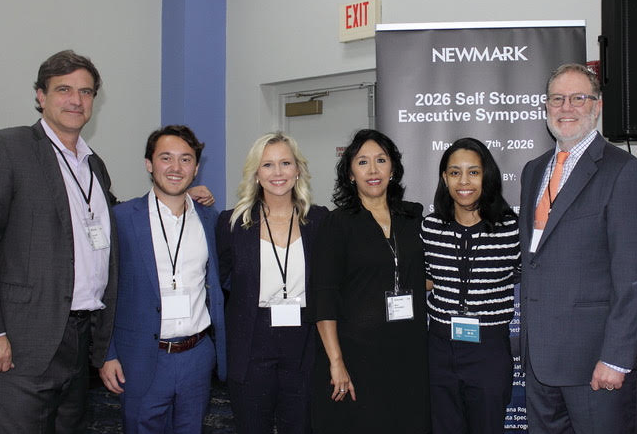
The self-storage sector is entering the second half of 2026 with growing confidence, according to discussions at the 2026 Newmark Self Storage Executive Symposium, where industry leaders pointed to strengthening transaction activity, improving capital markets conditions, and accelerating adoption of artificial intelligence as key drivers of optimism.
The annual event drew strong participation from private operators, publicly traded real estate investment trusts (REITs), private equity firms, and institutional investors. While attendees expressed the strongest confidence in transaction activity, sentiment toward operating fundamentals also remained positive.
Industry executives identified slowing new supply as the most significant macroeconomic tailwind for self-storage. Fewer new facilities entering the market are easing competitive pressure on street rates, though development timelines and stabilization periods remain extended compared to historical norms.
Transaction activity emerged as a major theme throughout the symposium. Panelists reported significantly stronger deal pipelines in 2026, with some platforms completing 25% to 50% more transactions during the first half of the year than they completed during all of 2025. Institutional investors also indicated plans to increase allocations to self-storage, with many positioning themselves as net buyers over the next 12 to 24 months.
Participants noted that narrowing bid-ask spreads and abundant capital for core-plus and value-add investments are contributing to a more active acquisition environment. Capital markets were described as functioning efficiently, with debt financing remaining widely available and cap rates expected to remain relatively stable.
Operating performance remains supported by revenue management strategies and consumer mobility trends. Existing Customer Rate Increases (ECRIs) have become a primary source of revenue growth for many operators, often generating increases of 20% to 50% for existing tenants while tenant retention and lengths of stay continue to improve.
Industry leaders also noted that street rates are increasingly being used as customer acquisition tools rather than the primary driver of revenue, with operators focusing more closely on net effective rates. Seasonal fluctuations remain less pronounced than before the pandemic, although strong summer leasing activity and healthy occupancy levels continue to support performance.
Consumer mobility was cited as another important demand driver. Panelists estimated that approximately 15 million people relocated during the past year, with most moves occurring within the same state and driven by life events rather than housing transactions. The growing number of long-term apartment renters facing space constraints is also contributing to increased self-storage utilization.
On the expense side, operators reported improving insurance conditions, with some portfolios expecting premium reductions in 2026 while maintaining coverage levels.
Despite advances in automation, executives emphasized the importance of maintaining an omnichannel customer experience. While digital adoption continues to grow, roughly one-third of tenants still prefer face-to-face interactions, reinforcing the need to balance technology investments with traditional customer service.
Development activity remains challenged by construction costs and longer entitlement timelines. Panelists said the current street-rate environment has become the primary obstacle to new projects, extending stabilization periods from a historical three-to-four-year range to five-to-six years in many markets.
While national supply growth is slowing, executives stressed that the impact of new development remains highly localized. Markets that experienced significant supply additions since 2019 continue to face pricing pressure, while many Midwest and Rust Belt markets with limited recent development are outperforming on operating fundamentals.
Artificial intelligence was another focal point of discussion, with industry leaders describing a rapid shift from basic automation to advanced operational applications. Companies reported managing more than a dozen active AI use cases across their portfolios, applying the technology to underwriting, pricing, customer service, and administrative functions.
Executives said AI is significantly reducing the time required to analyze rent rolls, build unit-level pricing models, and prepare investment committee materials. Some operators also reported measurable savings through conversational AI platforms. One company said it replaced a traditional rollover call center with an AI-powered system that handles up to 80% of after-hours calls, generating approximately $10,000 in monthly savings.
Overall, discussions at the event reflected growing confidence that improving transaction activity, moderating supply growth, and technology-driven efficiencies will support the sector's medium- and long-term outlook.
The symposium also featured the annual Newmark Ping Pong Tournament, where James Denissen captured his third consecutive win in the varsity division, while Daniel Ginburg took second place. As for the JV division, Doug Steverson earned first place and Chris Dufault came in second. In addition to commemorative trophies and plaques, all four winners were awarded free registration for MSM’s THE Show, which is being held in Atlanta, Ga., from Nov. to Nov. 6.
Visit www.modernstoragemedia.
Popular Posts

Joe Shoen is taking a stand. In our...

Self-storage software is no longer...

Joe Shoen has had enough.

The self storage industry is in a precarious...

From policy pivots in Ottawa to tariff...

Joe Shoen, CEO of U-Haul, has had enough.

This interview is from July 24, 2024.
Some recent lower court decisions have been...

Rising tides lift all ships, but in 2025 it...

In a record-breaking deal finalized May 12,...
Recent Posts



Most growth strategies in self-storage...

Stability and resiliency in the...

The age of artificial intelligence poses a...
.jpg)
The roar of the 1920s came to an abrupt halt...

Scott Jennings should not have been a...
The phrase “click to cancel” has become...
