
Self-storage software is no longer optional—it’s the backbone of modern facility management. The market was worth $2.5 billion in 2024, and it’s growing at 12.7 percent annually, driven by automation, real-time analytics, and contactless services.
Operators now expect more than basic booking tools. The leading platforms deliver contactless reservations, automated billing, portfolio-wide dashboards, seamless integrations, and built-in communication systems. The payoff: lower overhead, higher occupancy, and a better tenant experience.
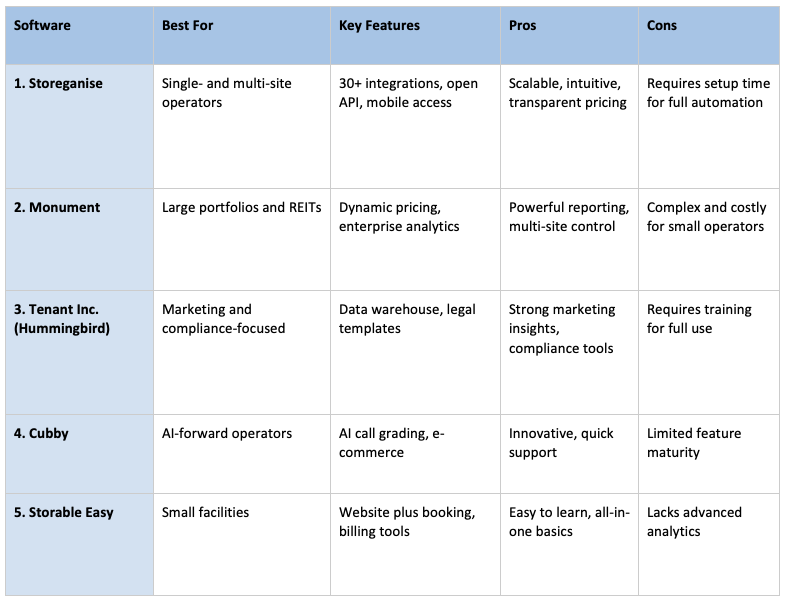
This guide compares five of the top self-storage software platforms available in 2025, helping operators identify the solution that best fits their business goals.
Methodology
Choosing the right self-storage software requires more than scanning a feature list. This roundup was researched and written by drawing on years of experience working with self-storage facility owners to improve operations through automation, AI-driven workflows, and SEO strategies. The evaluation reflects both an operational perspective, optimizing day-to-day tasks and customer interactions, and a marketing perspective, driving occupancy through digital strategies.
Each platform was reviewed against the core needs of facility owners, including booking automation, billing accuracy, reporting depth, ease of integration, and tenant communication tools.
By combining real-world operational insights with structured feature analysis, this guide offers recommendations that balance technical capabilities with practical, everyday usability for self-storage businesses.
The Top Five
1. Storeganise
Storeganise is an award-winning management platform trusted by more than 1,200 facilities in over 40 countries. Designed for both single-site and multi-site operators, it combines automation, real-time reporting, and a highly intuitive interface to streamline day-to-day operations.
With 30-plus native integrations and a flexible open API, Storeganise adapts to virtually any workflow. Operators can oversee bookings, payments, and access control from a single dashboard, while tenants can manage bookings, payments, and accounts entirely online. This reduces admin workload and boosts customer satisfaction. Mobile access keeps both staff and tenants connected, enabling key tasks to be completed anytime, anywhere.
Pros
It has transparent pricing starting around $50 per month for 100 units.
Scalable for operators of all sizes, from independent sites to large portfolios
Customizable localization for tax, currency, and language settings
Interactive site maps with color-coded occupancy
GDPR compliance and secure logins for data protection
Cons
Setup and training are required to unlock its full automation capabilities.
Storeganise stands out for its balance of operational efficiency, ease of use, and global scalability, making it a strong choice for operators who want automation without sacrificing flexibility.
2. Monument
Monument is built for large-scale operators such as REITs and multi-site portfolios that need advanced revenue management and detailed operational control. Its enterprise-level analytics help owners monitor performance across locations, optimize pricing, and streamline leasing processes.
The platform’s unified dashboard provides an instant view of occupancy, financial metrics, and operational tasks across all facilities. Dynamic pricing tools adjust rental rates based on demand and competitor data, while smart leasing features, such as e-signatures and automated follow-ups, help reduce vacancy periods. Monument also integrates with leading gate access and payment systems, ensuring seamless operations from move-in to payment processing.
Pros
Powerful, portfolio-wide reporting and analytics
Dynamic pricing to maximize revenue based on market conditions
Strong automation for leasing and operational workflows
Integration with major access control and payment systems
Cons
Its complexity may overwhelm small operators.
Pricing is available only via a custom quote, making it potentially higher than other options.
Monument’s depth of analytics and enterprise-level capabilities make it ideal for owners managing multiple facilities who need granular insights and advanced revenue optimization tools.
3. Tenant Inc. (Hummingbird)
Hummingbird by Tenant Inc. is designed to connect marketing performance with operational efficiency, giving storage operators a clearer picture of how their business is performing end to end. Developed by industry professionals, it focuses on reducing manual admin work while providing data insights that drive higher occupancy and revenue.
Its integrated data warehouse links rental activity to advertising campaigns and customer reviews, allowing operators to see which marketing channels deliver the best ROI. Built-in compliance features, including verified lease templates and state-specific lien notices, help operators meet legal requirements without additional tools. Automated workflows manage routine tasks like reminders, notices, and reporting, freeing staff to focus on customer service.
Pros
Direct connection between marketing analytics and rental activity
Built-in legal compliance tools for leases and notices
Automated workflows to reduce manual admin work
It’s designed by storage industry professionals for real-world use.
Cons
Training may be required to fully leverage data and automation features.
Hummingbird is best suited to operators ready to adopt a data-driven approach, combining operational tools with marketing insight to improve decision-making and compliance.
4. Cubby
Cubby is a newer entrant in the self-storage software market offering a fresh, modern interface and rapid feature development. It’s built for operators who want to leverage AI-powered tools and e-commerce capabilities to improve both operational efficiency and customer experience.
The platform’s AI communication tools transcribe and grade incoming calls, helping staff identify missed sales opportunities, and improve service quality. A centralized messaging hub consolidates all tenant communications (email, SMS, and calls) into a single view. Cubby also includes e-commerce functionality, allowing operators to launch custom booking sites or embed checkout tools directly into their existing website.
Pros
AI-powered call transcription and performance grading
Centralized communication hub for all customer interactions
Built-in e-commerce booking tools
Fast development cycles and responsive support
Cons
Its feature set is still expanding compared to more established platforms.
Cubby is best for tech-forward operators who value innovation, want to integrate AI into daily workflows, and are open to adopting a platform that evolves quickly with new capabilities.
5. Storable Easy
Storable Easy, formerly known as Easy Storage Solutions, is built for independent facility owners who need core functionality without the complexity of enterprise platforms. Its all-in-one approach combines a booking-enabled website, payment processing, and basic communication tools in a single, easy-to-learn system.
Operators can offer online reservations and payments, automate recurring billing, and manage tenant communications via SMS, email, or voice—all within the same platform. Real-time financial reporting helps track deposits, income, and performance at a glance. Cloud-based access allows owners to handle move-ins, lockouts, and other tasks remotely without being on site.
Pros
Simple interface with minimal learning curve
Website, booking, and billing tools are included.
Built-in SMS, email, and phone communication features
Cloud-based remote management
Cons
It lacks the advanced analytics and revenue optimization tools needed for growth-focused operators.
Storable Easy is an ideal choice for small facilities or new operators who prioritize ease of use and affordability over advanced customization and enterprise-grade reporting.
Choosing The Best Software
Selecting the right platform is not just about comparing feature lists—it’s about finding a solution that matches your facility’s size, growth plans, and operational priorities. The best choice simplifies your day-to-day processes while giving you flexibility to scale as your business grows.
Match Software To Scale
The size of your operation should be your first filter. Smaller facilities and new operators usually benefit from straightforward, all-in-one solutions that cover the essentials (online booking, billing, and basic reporting) without adding complexity. Large operators or REITs often require enterprise-level tools such as portfolio-wide dashboards, dynamic pricing, and advanced analytics. Choosing software that’s too complex for your needs can lead to wasted time and higher costs.
Focus On Pain Points
Every facility has unique challenges. If late payments and delinquency are frequent issues, look for platforms with strong automated billing, late-fee management, and lock-out features. If you struggle to track marketing effectiveness, prioritize systems that link rental activity to ad performance data. For customer service improvements, seek out platforms with integrated communication tools so calls, emails, and texts are logged in one place for easy follow-up.
Test Its Usability
Powerful software is only valuable if your team can use it effectively. Request a demo or trial period and have your staff complete everyday tasks such as move-ins, rate adjustments, and generating occupancy reports. Pay attention to how intuitive the interface feels and how much training would be required for new users.
Integrations And Long-Term Costs
Your software should connect seamlessly with the systems you already use, such as gate access, payment processors, and CRMs. Integration gaps can lead to manual workarounds that undo the benefits of automation. When budgeting, consider the full cost of ownership—not just the monthly subscription fee. Implementation, training, add-ons, and support should all be factored into your decision.
Think Ahead
Finally, remember that the self-storage industry is evolving quickly. The platform you choose today should not only meet your current needs but also adapt to future trends like AI-driven pricing, contactless move-ins, and expanded communication channels. A forward-compatible system will save you from costly migrations later.
The right self-storage software can streamline operations, improve occupancy, and provide a better tenant experience. While several platforms stand out, Storeganise offers a strong mix of automation, scalability, and ease of use, making it a solid choice for many operators.
However, the best fit depends on your facility’s size, challenges, and growth plans. Test each option, check integrations, and consider long-term costs before committing. In a rapidly evolving industry, investing in adaptable, data-driven software will keep your business competitive and ready for future opportunities.
–
Henry Purchase is the founder of SEOSpace, The SEO Tool for Squarespace.
Popular Posts

Joe Shoen is taking a stand. In our...

Self-storage software is no longer...

Joe Shoen has had enough.

The self storage industry is in a precarious...

From policy pivots in Ottawa to tariff...

Joe Shoen, CEO of U-Haul, has had enough.

This interview is from July 24, 2024.

In a record-breaking deal finalized May 12,...

Some recent lower court decisions have been...

Rising tides lift all ships, but in 2025 it...
Recent Posts
The phrase “click to cancel” has become...

It began with a handful of consumer...

Business involves a lot of planning:...

It’s the kind of incident that shakes...

As self-storage demand continues to grow in...

When customers entrust their physical...

The self-storage industry has spent the...

The self-storage industry has spent the...