

Occupancy data is arguably the hardest data to uncover when looking at any market. Unlike rental rates, there aren’t web scraping tools that gather occupancy data because the data is not publicly available on websites. One way to gather occupancy data in a market is by calling self-storage facilities in the area and asking for the data directly. Some owners and operators are willing to share this data, but others keep it confidential out of fear of losing a competitive edge.
Another way to get occupancy data is through publicly available sources. There are several publicly traded self-storage companies that publish quarterly and annual data on occupancy. Let’s dive into self-storage REIT occupancy trends since 2017.
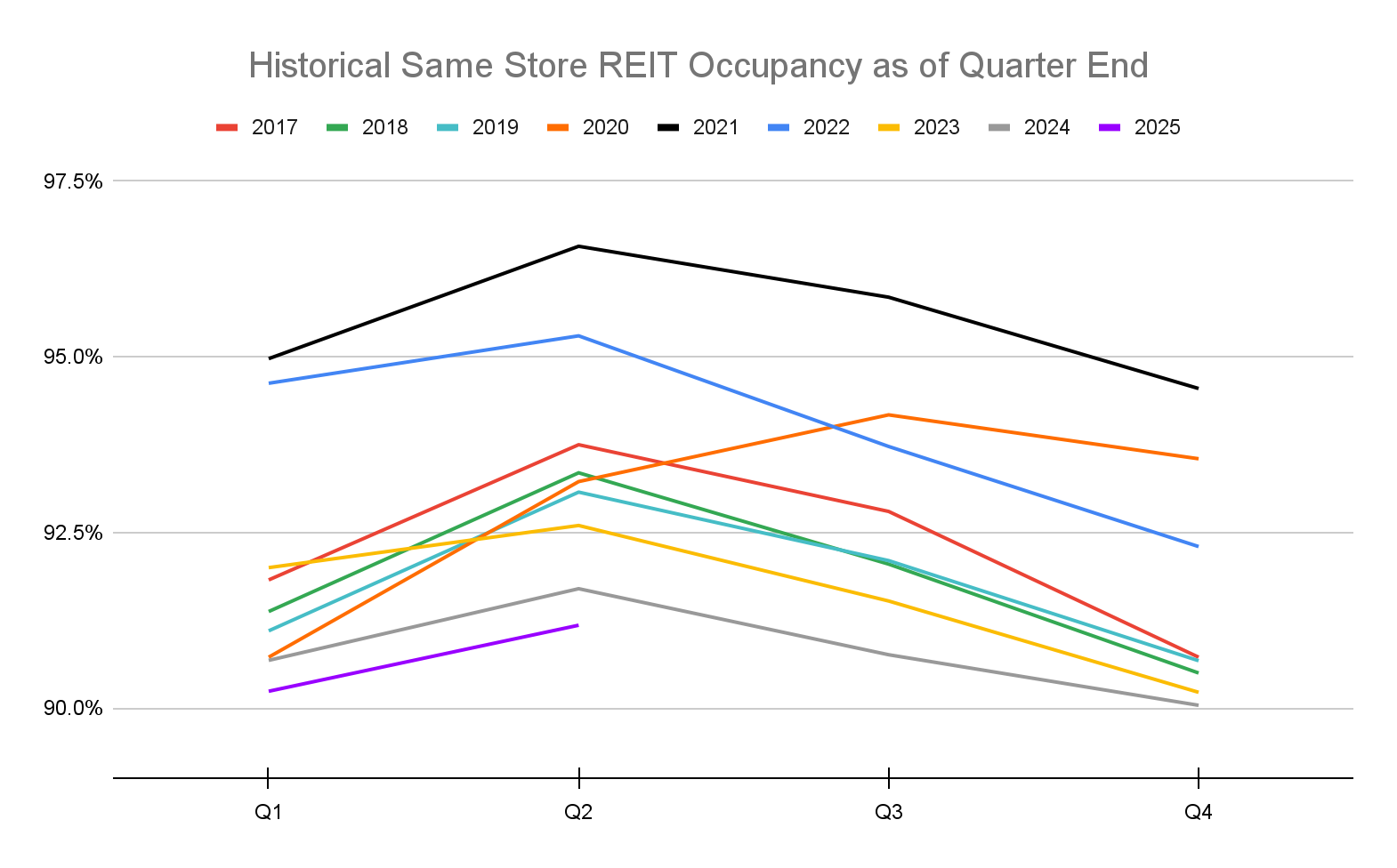
It is important to keep in mind that the data in the chart comes from same-store portfolios for publicly traded self-storage companies. Each company defines same store differently; in general, same store can be viewed synonymously with stabilized from a rental rate or occupancy perspective.
There are three items worth noting from the data in the chart:
Seasonality - You will notice distinct highs and lows in the chart showing increased occupancy in Q2/Q3 and decreased occupancy in Q4/Q1. The data highlights a higher need for storage during the spring/summer months, when residential migration is typically higher.
2020 was abnormal - The COVID-19 pandemic year created outsized demand for self-storage due to increased residential mobility, which is why Q3 and Q4 occupancy were higher than Q2 for that year (the only time this has happened in the last eight years).
2025 hits rock bottom - Although we don’t have all the data yet for 2025, Q1 2025 started off with the lowest occupancy rate for Q1 since 2017. Inflation, high interest rates, and general uncertainty have plagued the overall real estate market since 2022, resulting in lower occupancy. It will be interesting to see if occupancy has truly bottomed out, or if 2026 will set a new record.
It is important to disclose that this data on occupancy is not a representation of the entire self-storage industry. The data is a small sample size compared to the rest of the industry. For example, the number of facilities that make up the same-store pool for the four publicly traded REITs and U-Haul presented in this data does not exceed 7,000 facilities. That is less than 10 percent of the total number of facilities in the country. These facilities are also most likely the highest performers out of the entire industry, in the best condition, and located in the best markets.
Even though occupancy data isn’t widely available, it’s important to look at what is available through public sources like self-storage REITs and other public companies. At the very least, you will uncover trends that are vital to understand when evaluating deals.
–
Noah Starr is the CEO of TractIQ.
Popular Posts

Joe Shoen is taking a stand. In our...

Self-storage software is no longer...

Joe Shoen has had enough.

The self storage industry is in a precarious...

From policy pivots in Ottawa to tariff...

This interview is from July 24, 2024.

Joe Shoen, CEO of U-Haul, has had enough.

Some recent lower court decisions have been...

Rising tides lift all ships, but in 2025 it...

In a record-breaking deal finalized May 12,...
Recent Posts



Most growth strategies in self-storage...

Stability and resiliency in the...

The age of artificial intelligence poses a...
.jpg)
The roar of the 1920s came to an abrupt halt...

Scott Jennings should not have been a...
The phrase “click to cancel” has become...